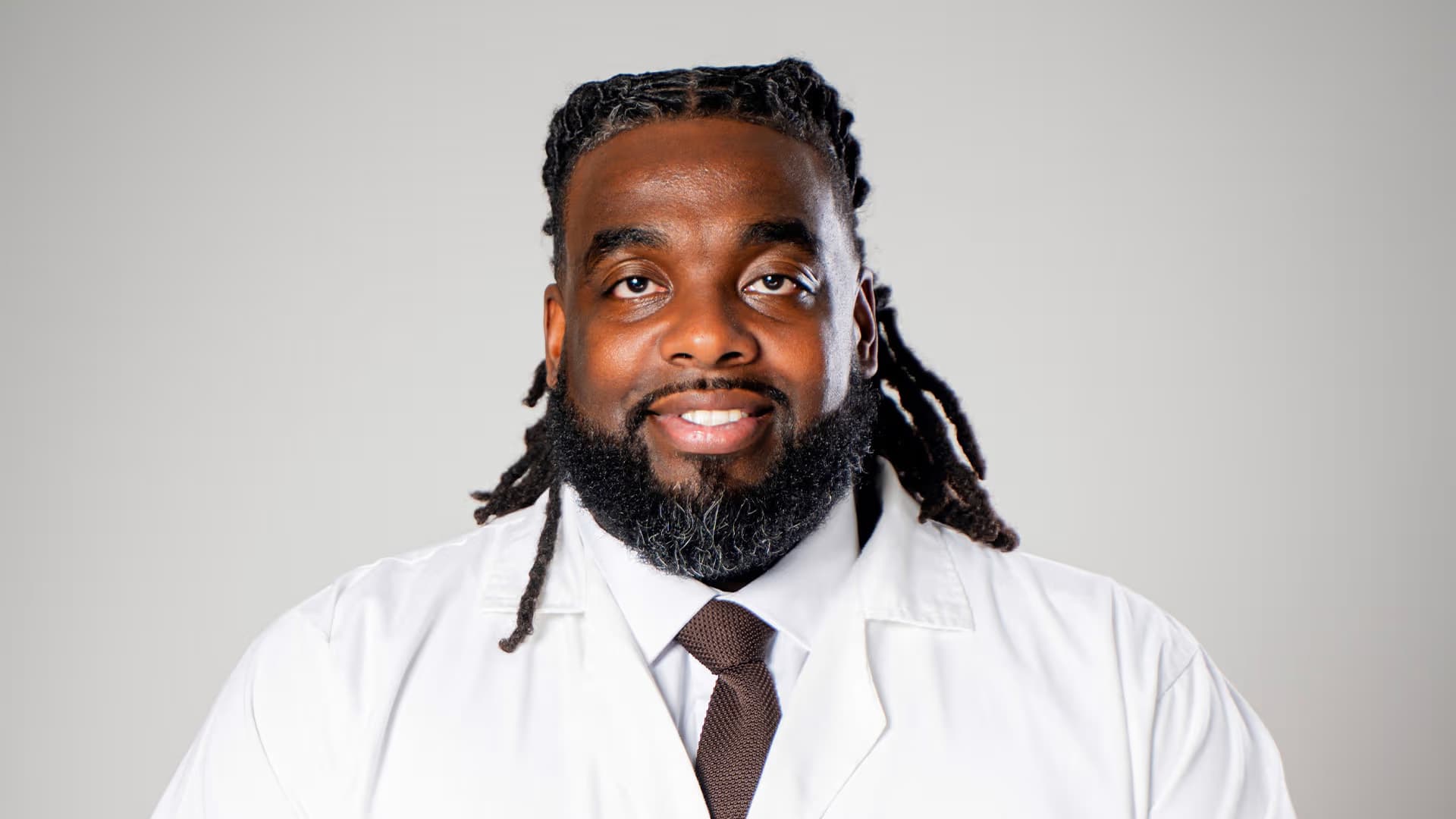
Russell J. Ledet was told that security guards don’t become doctors. He didn’t accept this stereotype.
In conversation with AFROTECH™, the Lake Charles, LA, native admitted that all he could afford to do as a kid was dream. His mother worked as a certified nursing assistant, earning minimum wage and navigating poverty and food insecurity while caring for him. She still nurtured his imagination by ensuring he had access to books, bringing them home from the hospital when he couldn’t access the larger, segregated library.
“I always knew that where I was growing up wasn’t everything. It wasn’t the totality of what I could potentially have access to,” he acknowledged.
After graduating from high school, he joined the Navy, which made him realize that he could pursue more career paths than those he witnessed growing up. He served on active duty for the first five years, spending the first two as a ceremonial guard before transitioning to cryptologic intelligence.
View this post on Instagram
While on active duty, he was deployed twice, which was a concern for his wife, so he decided to transition to the reserves. There, he took a full-time job as a security guard at the Baton Rouge General Hospital-Mid City Campus, gaining exposure to medicine.
When considering his future, his wife suggested he enroll in college, which never dawned on him because he thought “only white people go to college.” She helped him enroll at Southern University and Agricultural and Mechanical College at Baton Rouge under the GI Bill.
At the start of his degree, Ledet studied social work. Still, his chemistry professor, Mrs. Sharon Chriss, noticed how smart he was in the classroom and encouraged him to switch his major to chemistry, which he did. By the end of his freshman year, he was pursuing a double major in chemistry and biology. Professor Chriss introduced him to Jamaican native Dr. Wesley Gray, who became a mentor for Ledet, introducing him to research and encouraging him to pursue a career as a medical doctor.
“When I was being exposed to research and simultaneously being exposed to medicine by working as a hospital security guard, those two things kind of melded together to biological research, physician scientists, M.D., Ph.D., all these things became considerations. These are pathways forward. This is a route forward. I don’t know which route I’d end up taking,” Ledet mentioned.
He also recalled feeling “enamored” by the lives being saved at the hospital, so much so that he wanted to shadow the doctors and pursue medicine.
“I asked so many doctors, ‘Can I shadow you?’ And they’d be like, ‘Nah, bro. Security guards don’t become doctors.’ They were right. Security guards don’t become doctors. Security guards become double doctors,” he said in reflection.
One doctor recognized Ledet’s brilliance early on. In October 2010, Ledet met Dr. Patrick Greiffenstein, who remained a longtime mentor and allowed Ledet to shadow him at the hospital.

In 2013, Ledet enrolled in a Ph.D. program in molecular oncology at NYU School of Medicine. In 2018, he was admitted on a full scholarship to Tulane University School of Medicine. He simultaneously enrolled in the university’s MBA program. Together, these programs awarded him an M.D., Ph.D, and an MBA. He decided to specialize in pediatrics, adult psychiatry, and child and adolescent psychiatry.
He matched into Indiana University School of Medicine’s five-year Triple Board Program, making history as the first Black man to ever enroll in the program and reportedly the only Black man to match into any Triple Board Residency through the National Resident Matching Program, according to the school.
“I just became what I didn’t have when I was a little Black boy,” Ledet said.
View this post on Instagram
Ledet completed his residencies for pediatrics and adult psychiatry and is currently an adult psychiatrist and child and adolescent psychiatry fellow. He will be taking his pediatrics board examination in October, his adult psychiatry board examination in 2027, and his child and adolescent psychiatry board examination in 2028, he told AFROTECH™.
The 15 White Coats
Ledet is on a mission to reshape and diversify the future of healthcare by supporting the next generation of physician leaders, so he co-founded nonprofit The 15 White Coats in 2019, which provides scholarships, structured mentorship, and prep for the medical college admissions test, according to information on its website.
The 15 White Coats has helped between 50 and 60 people get into medical school, Ledet told AFROTECH™.
“[We’re] making sure that more Black people go to medical school,” he said.
Ledet has visited numerous classrooms as part of the project and is currently embarking on an HBCU tour that has reached Spelman College, Morehouse College, Morris Brown College, and Clark Atlanta University.