All results



On the current trajectory, it would take roughly 95 years for Black professionals working in the national private sector to reach 12 percent representation in management roles, a new report finds. McKinsey & Company published this finding amongst others in its inaugural Race in the Workplace: The Black Experience report. The new report studies Black professionals working in the U.S. private sector, diversity, equity and inclusion programs and what economic success looks like. Walmart, the W.K. Kellogg Foundation, PolicyLink and the McKinsey Institute for Black Economic Mobility collaborated to conduct research on 24 national companies, which represent 3.7 million employees. Monne Williams, Atlanta partner at McKinsey & Company and co-author of the new report, told AfroTech that McKinsey invited a number of companies and they had to opt-in to participate. This initial report focuses on large employees with good industry representation, she said. “We looked at current representation...


One in three BIPOC tech employees feel discriminated against by their employers, a new report finds. While a third of minority tech workers aren’t feeling comfortable at work, 67% of them said their company has a diversity and inclusion team that’s supposed to be focused on making sure they feel welcomed and supported, according to information provided to AfroTech. These findings were published by global data and market research company Savanta. Lead researchers Sadia Corey and Daniel Garcia wanted to publish this report after the civil unrest that swept the nation last year. “We really felt like after the movement from the summer, George Floyd’s death and some of the protests that were happening, we wanted to keep the conversation going and bring some statistics to some feelings and sentiments that we already know about in the U.S. workplace,” Corey told AfroTech. As part of Savanta’s Black Lives Matter: Everywhere, Amplifying the voices of minorities in the workplace report, there...
![[WATCH] Netflix Shares Its First-Ever Inclusion Report in New Short Film](/_next/image?url=https%3A%2F%2Fcdn.afrotech.com%2Fwp-content%2Fuploads%2F2021%2F01%2Fphoto-output-15-compress.jpg&w=3840&q=75 "[WATCH] Netflix Shares Its First-Ever Inclusion Report in New Short Film")
Don’t talk about it, be about it! In the first-ever report of its kind, Netflix addresses inclusion within the company which they say in turn allows for a more inclusive platform for audiences. “Our work is internal first, it shows up in what we do externally,” said Vernā Myers, Netflix’s Vice President of Inclusion Strategy, in a short film that the company has released to showcase their findings. “If we’re creating the kinds of environments and policies and practices that not only invite people in but when they get in, they feel that there’s a level of investment in them, then we are going to see a real shift in our company and in the industries that surround us.” Inclusion was added as a cultural value for the company in 2017 and Netflix reveals they “weren’t as great as we thought we were or aspired to be.” In the short film, titled, “Sowing Seeds: Inclusion Takes Root At Netflix,” the company shares their latest strategies on diversity and inclusion not just in the consumer...
The consequences of the lack of diversity in tech can be severe. From algorithms that mistake Black people for gorillas to AI that can’t recognize dark-skinned women , tech has shown it needs to get it together and make their companies more representative of the world they operate in. Recently, Google released its fifth Diversity Annual Report . Although the tech numbers aren’t amazing, it shows some improvements over the past few years. To start, Google found its attrition rate — referring to how many employees leave a company annually — improved for almost every demographic. In general, Google saw improved attrition rates for employees of color in the United States, although that didn’t hold true for Native American employees. The greatest improvements happened with Black employees, mostly with Black men in both tech and non-tech roles. The company also found that women are less likely to leave Google, and it’s a pattern that’s even stronger among women in tech roles. However,...
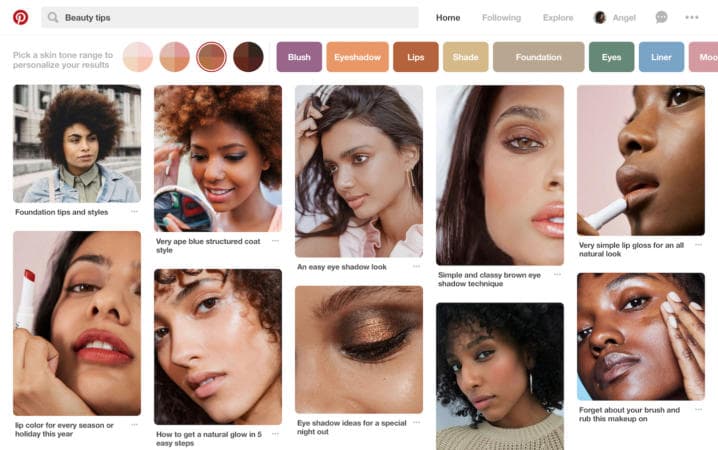
It’s no secret that there’s a lack of diversity in the beauty industry. Black and brown women have struggled to find representation in the products they’re using. Some brands are working fill this gap by creating products that cater to a more diverse customer base and finding ways to help them find resources and products that match their needs. Pinterest wants to be part of the shift that’s happening in the beauty industry. Today, the tech giant announced that it’s revamped it’s search feature for mobile to include skin tones. “You hear people talk about bringing together humans and machine learning to create balanced technology, but it’s so important that those people are diverse and can represent a range of people,” a spokeswoman for Pinterest said. The company began offering customizable beauty searches on the web in April using artificial intelligence from ModiFace, a company that specializes in AI and machine learning for the beauty industry. The company developed an algorithm...