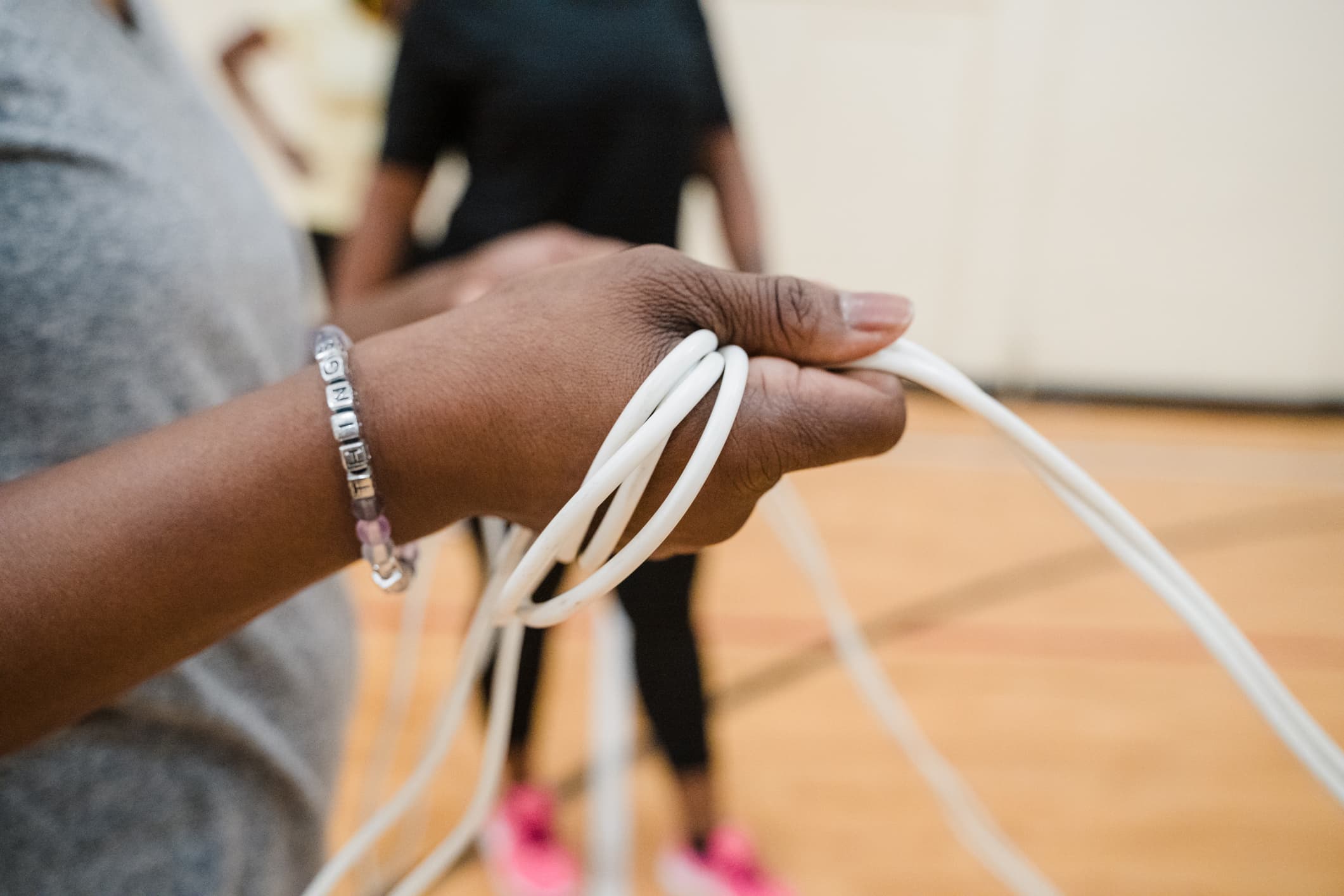
Inventor Tahira Reid Smith came up with a new way to enjoy a beloved hobby in the Black community.
Reid Smith knows Double Dutch all too well. Raised in The Bronx, NY, she was fond of the pastime. The Philadelphia Inquirer reports that she even sketched a Double Dutch machine when she was 8 years old. That drawing — which consisted of two poles and three buttons with a third grader jumping at its center — earned her first place in her school’s drawing competition.
That very concept would later evolve into an invention. Reid Smith’s educational pursuits led her to Rensselaer Polytechnic Institute, where she earned both a bachelor’s and a master’s degree in mechanical engineering by 2004, according to her LinkedIn profile. She then obtained a Ph.D. in design science from the University of Michigan in 2010.
Her time, particularly at Rensselaer Polytechnic Institute, brought her childhood sketch full circle under her late professor, Burt Swersey. The outlet reports Swersey gave Reid Smith a design assignment for his course, which emphasized sports and recreational activities. The project became an epiphany moment for Reid Smith, inspiring her to transform the childhood drawing into a working prototype.
Reid Smith, now a mechanical engineering professor at The Pennsylvania State University (Penn State University), also created an automated double-dutch training system built with the culture in mind and engineered for performance, according to its website. Swersey served as Reid Smith’s mentor during the development of the machine.